Friday, October 12, 2012

Palazzo Barberini


Let it never be said that a Barberini didn't spot a bargain
'What the barbarians left untouched the Barberini have destroyed'......when they plundered the copper roof off the Pantheon, but luckily they added the Baldechino to the Vatican and Urban VII, being an astute businessman, also added the beautiful palazzo that Alessandro Sforza was forced to sell in 1625 to his personal holdings.


The sloping site was developed by three great architects each bringing their singular vision to the project. Carlo Modeno was comissioned by the Sforzas to replicate the lines Palazzo Farnese but the design quickly evolved to incorporate a semi-enclosed garden in front of the building....he basically invented the front yard.


The work was started by the Barberini in 1627 and Carlo had a young nephew whom he brought in to help, Francesco Boromini. When in 1627 Carlo died, Boromini was passed over for Bernini, but he continued to work on the project. 


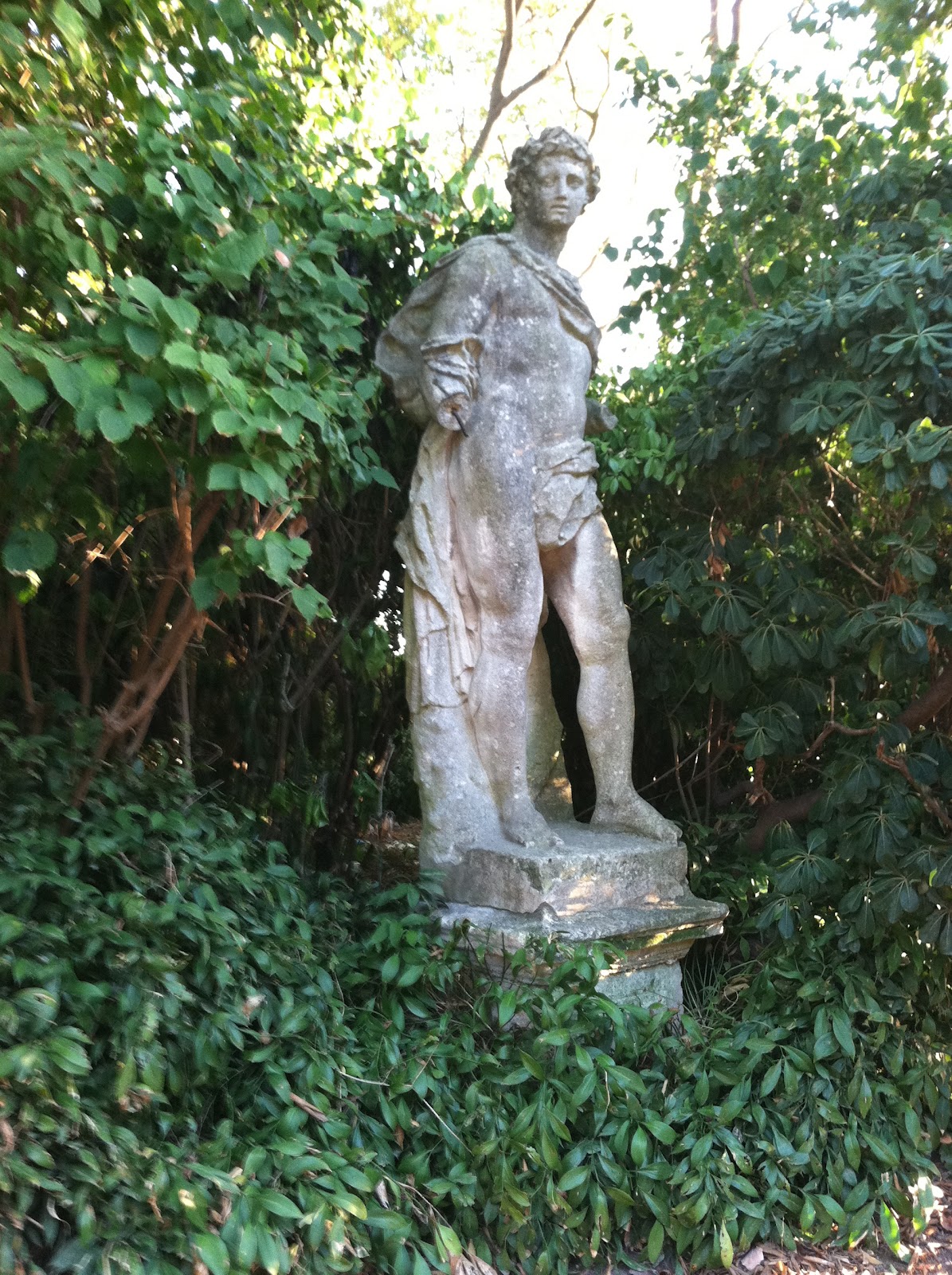
This is a statue of Apollo that belongs to one of the army buildings behind the palazzo....but it's on axis to the great stairs running through the building to the garden.


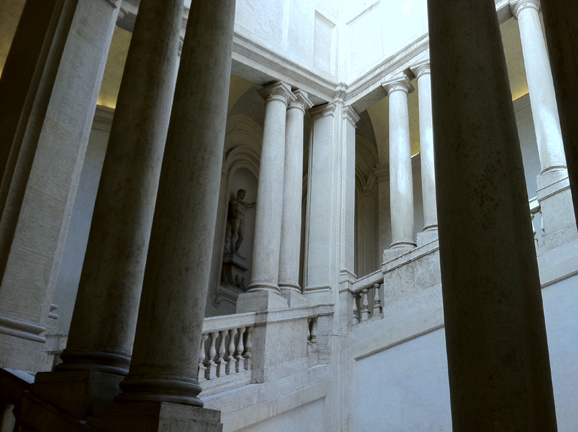
Courtyard with stairs


The famous helicoidal staircase by Boromini


The main stairway to the piano nobile


The building houses the Galeria Nazionale d'Arte Antica, so they don't allow photographs of the interior and there are tons of docents with eagle eyes....


The garden and the back of the Palazzo with a view of the greenhouses.

The palazzo is right up the street from The Tritone and the Via Veneto...worth a visit.


Tuesday, October 9, 2012

What I'm Looking At Today: Gloria Vanderbilt


I fell in love with Gloria Vanderbilt when I opened up a book and there she was in a full length gown, in her fabulous celery green living room with a full length portrait....nothing and no one could have been more glamorous for a little gay boy living in Elizabeth, NJ. 

Many years later I came across a book of Horst photos and the ever fabulous Ms Vanderbilt was again a standout. 

Ms Vanderbilt studied acting as well as art at the Art Student's League of New York. Well known for her one woman shows of oil paintings, watercolors and pastels she eventually licensed them to Hallmark Cards. In 2011 Ms Vanderbilt  opened her first exhibition 'Dream Boxes' at the southern Vermont Arts Center to critical acclaim.

Yesterday I encountered the artist's work in person at the 1st Dibs Showroom in NYC. The space is clean and fresh with super white walls and floors filled with her textured and multilayered paintings and collages.


A view of the gallery space


Celebration 1970


The gallery space with a painting 'Two girls in White' at the far end


Surprises 2002


Below are three wonderful pictures taken by Horst P. Horst from 1970 of Ms Vanderbilt in her fabulous apartment 


Below is my homage to the Queen of Decoupage, a show house in Nyak, NY with a floor created out of patchwork


The World of Gloria Vanderbilt is open thru October 24th at the 1st Dibs Showroom
200 Lexington Ave, New York City
646.293.6633


Sunday, October 7, 2012

Duomo of Florence


Meanwhile, in a town not far away from Siena, another church was being built....Santa Maria del Fiori 
is the church of Firenze built in the 14th c at the same time as that of Pisa and Siena. Built over the crumbling 5th c church dedicated to Saint Reparata, the current cathedral is one of the largest in Italy and is still known for it's great brick dome.

The church was designed by Arnolfo di Cambio  in 1294, architect of the Palazo Vecchio and the church of Santa Croce. The building took 120 years to complete with major changes to the eastern part of the church which was greatly expanded. One of the perks of taking down an old building is that you find some odd surprises.....I once found some old quarters and a newspaper from the 1940's but these guys hit pay dirt....they found the relics of St Zenobius in 1330. That was a lucky find as relics were better than gold and in 1331 the wool merchants guild assumed exclusive patronage of the building and hired Giotto to oversee the work. The tall campanile is his major design but alas in 1337, he died and so Mr Pisano of Siena was given charge until all work halted because of the Black Death of 1348.


View of the dome and campanile from the Uffizi terrace

Work began in 1349 and continued under various architects until in 1418 the Arte della Lana announced a competition. The two main contenders were Lorenzo Ghiberti, winner of for the bronze door competition of the Baptistry and Filippo Brunelleschi [ favorite of Cosimo Medici].

Turns out that Brunelleschi won but Ghiberti was named coadjutor and was given the same salary as the winner....but neither claimed or was given the prize money of 200 florins. Brunelleschi decided he was 'ill' and so Ghiberti took over but soon gave up and at that point sole responsibility came to Brunelleschi who finished the dome from 1420-1436. There's a story that when asked how he was going to build it, he took an egg and smashed the wide end on a table making a 'dome' and he said....like this'. It is the first octagonal dome in history to be built without temporary support each brick is held in place by the weight of the brick above it.


Looking at the polychome marble decoration which was begun in the 14thc and not completed until 1887 under Emilio de Fabris.

Below, looking up to heaven. The decoration of this cathedral is much more sedate than that of siena...plain white walls hardly and decoration anywhere.


 The cathedral has seen it's share of bloody history when it witnessed the murder of Guliano Medici and the near death of Lorenzo il Magnifico. 


The Baptistry below was built on the Temple of Mars. Like most Baptistries it is dedicated to st John and is octagonal, 8 being the number of rejuvenation in Christian lore.


beautiful floors

below is the amazing gold mosaic decoration


The Baptistry is known for it's doors which are now in the Opera behind the cathedral, it was in use until the 19th c.

The Duomo entrance is free, the Baptistry is currently 5 Euro, you buy your tickets next to the  fancy ice cream shop on the right. Be prepared to wait a long long time.


Saturday, October 6, 2012

The Duomo of Siena


Italy is one of those places where less is not more....even today when you see Italian 'minimalist' design, there's a ceratian bravura, a look at us we can out minimal you....luckily no one subscribed to minimalism back when Firenze and Siena were vying for supremacy and the Cathedral of the city with it's tower and dome are clad in horizontal marble stripes and filled with amazing art.

The church is, as are all such places, built on the foundations of an earlier building atop earlier temples. In the 9th c there was a cathedral and Bishop's palace on the site and in 1196 the cathedral's mason's guild was given charge to build a new structure....who says government doesn't create jobs.

The work began with a north-south transept and a plan to add a massive addition later on. In 1339 the main body of the  building was planned and outined, but it was not to be, Construction was halted by the Black Death in 1348, add that basic errors in construction were already in evidence and that was that....the unfinished outer wall is all that remains of the audacious plan. We climed to the top, well worth it for the view, although they only allow you 10 minutes and if you're claustrophobic quite an experience....did I say germaphobic too? nothing to hold onto other than a very greasy pillar on a spiral stair with treads the size of a slice of pizza.....


A view of the Duomo from Santa Catherina


The striped black and white facade is one of the most fascinating in Italy. Designed in 1284 by Giovani Pisano it incorporates French Gothic, Tuscan Romanesque and Classical architecture. In 1296 work was taken over by Camino di Crestini when Mr. Pisano abruptly left the city.

Pisano had planned on raising the nave to accommodate the installation of a large Rose Window designed by Duccio.


The striking black and white interior with the octogonal dome.

The whole thing is very chic.


The high altar was built by Balsassare Peruzzi in 1532. There's an enormous ciborium which was originally commissioned from Vecchietta for the church across the piazza, the Hospital di Santa Maria della Scala and brought to this spot in 1506. The four angels were add-ons and the two uppermost are considered masterpieces by Francesco di Giorgio Martini. 


The pulpit is made of Carrara marble. Sculpted between 1265-68, it's the work of Nicola Oisano and other unnamed artists. The story depicetd is of man's salvation and the Last Judgment..better be good! Prophets and the four Evangelists sit around a carousel supported on lions.....a great piece of northern Gothic whimsy.


Looking up at the dome. It's a little off, but it hasn't fallen yet...


Looking up at the nave


Below is the Madonna del Voto in her gilded chapel. Right outside are gifts left to commemorate personal miracles


The gilded dome in this small side chapel. These spaces always leave me in awe, that they were built at all and that people still believe the church is poor!


The cathedral is known for it's floors. Almost every inch is covered in fine mosaic work. This is the 'She wolf of Siena'. Most of the floors remain covered year round and are exposed for only several days a year.


The Piccolomini Altarpiece in the left nave was built between 1481-85. The impressive frame was made out of Carrara marble by the young Michelangelo to house the Madonna col bambino by Giovanni di Cecco


Below are pictures of the unfinished parts of the church which abutt the cathedral's Opera


Looking up at the unfinished arch from above the rose window


Looking at the roof and bell tower

I will do a blog later of the view......

Walk right to the kiosk and buy your famila ticket....let's you in to the catherdal, the opera with all the removed statues from the facade[no pictures please], the observatory arch and the baptistry. Well worth the day.


There was a young man in rennaissance attire getting into a newfangeld modern contraption.

I love Siena. It's a jewel. I won't say undiscovered, but most definately under appreciated. There are swarmng crowds all day in Firenze, now don't get me wrong, that's a great city, but it has lost a good deal of it's charm. Siena is still managable and very charming and the art is first rate.

Friday, October 5, 2012

What I'm Looking At Today: Lead Garden Ornaments

It's always a good time to plan and plant a garden, and so i'm looking at some ornaments that might do well in a project or two....I always like to put a statue in an unexpected place...set in among trees or maybe near water and one of my favorite materials is lead. 


A river god


I sometimes also use stone ornaments
Tucked in the woods


some classic planters


A great looking fountain


And the best thing about these types of garden ornaments is that they can always be used inside as well


Wednesday, October 3, 2012

Baths of Diocletian

Rome is an ancient city. You'd think it was walkable, which it is, but it's always best to tackle it in quadrants and to take your time while you do it...in the ancient city, an afternoon at the baths would have been a nice respite from the heat of the day and in 298 AD Emperor Diocletian decided to take 32 acres and build the good citizens of Rome new facilities. Today, a part of the building remains as Santa Maria of the Angels, the remainder of the complex is one of Rome's four great National Museums incorporating the cloister  of the charterhouse attributed to Michelangelo.


Entering the courtyard right across the Roma Termini.


The museum built into the ruins.


The front garden with a huge antique urn.


A model showing the entire site.


The hall to the cloister is lined with sculpture and some remnants of frescoes.


The main stairs


A wonderful mosaic of an athlete


There are these amazingly beautiful terracotta ladies. Almost lifesize all seated on wonderful Roman chairs. The features are sensitively rendered.


A fresco of a monk in his study greets you in the cloister


100 arches on four sides create the cloister designed by Michelangelo, but built posthumously.


Staues and sarcophagi line the halls while a lovely garden and fountain are guarded by antique wild beasts.


Detail of a sarcophagus


The newest section of the museum to open is the calderium


One of two funerary crypts moved to the site in the late 50's and entirely restored.


A view of the vast space which would have been decorated with colorful marbles


A section still under restoration and not yet open to the general public


Be sure to visit this and the Palazzo Massimo along with the Palazzo Altemps, you can buy a 3 day pass to the four National Museums. The least interesting of the four is the Crypta Balbi so leave that one for last.